Well, well, well, we are back again for a new month!
And this first post of March was inspired by the first back on the blog which you can read here in case you missed it. Since color is so important in storytelling, what happens when it doesn’t apply? How does it change our perception?
A recent example of this would be The Mist (2007). There are two versions that exist: one in color and one in black and white. Which one do you prefer and why? I know a lot of people like the black and white version which I find so fascinating because I agree with them. I think the overall execution is what works well with that film being without color.
But what about a well known film that doesn’t have a color option? And I chose this film specifically because of the reason why this film was chosen to be in black and white. And we know this film, it’s iconic, legendary, influential and even if you aren’t a fan of horror, you know this film!
We’re going to discuss Alfred Hitchcock’s 1960 film adaptation of Robert Bloch’s Psycho.

This is a summary from the encyclopedia guide to the greatest horror and fantasy films of all time, “Horrors: From Screen to Scream” by Ed Naha, on page 237, it reads:
Psycho, Paramount 1960 – “Famous Hitchcock shocker. When Janet Leigh takes off from the bank where she is employed with a large chunk of the day’s receipts and flees to a secluded house, she doesn’t plan to encounter nutty Norman (Tony Perkins, interesting we call him Tony here), a decidedly psychopathic lad who keeps his mother in the basement. Unfortunately for all concerned, mom’s been dead for quite a few years and Janet joins her in Valhalla via the film’s famous shower bath backstabbing scene. Norman assumes both mother and son roles undisturbed until detective Martin Balsam arrives. He soon makes the mother-Janet Leigh twosome a threesome. John Gavin and John McIntire save the day. Script by Robert Bloch and Joseph Stafano is interesting at times.”
Okay so fuck Vera Miles, right? Why wasn’t she mentioned in this? I… whatever, this won’t become a rant but isn’t interesting how this author describes this film in a very surface way? It was published in 1975 so not a lot of time has passed to thoroughly reflect but my goodness. The book also mentions in the introduction that “What you have here is a book of monsters. It’s not a work to be studied or dissected. It’s a book to be enjoyed, listing alphabetically a batch of the best known (and unknown) fantasy epics ever filmed and a host of actors, producers and directors who gave them life on screen.” Except the other female lead in Psycho but okay.
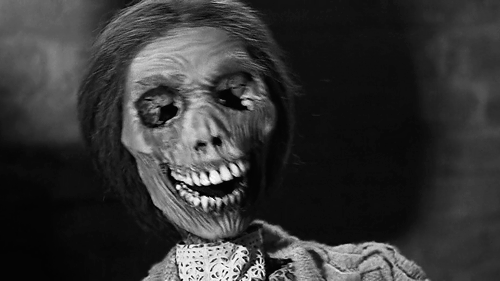 I wanted to share this because 1, I think it’s interesting to talk about a film that at that time was only 15 years old and its focus is on the character of Norman Bates and nothing else compared to now, 65 years later and we have enough time to talk about the film making, background work, the influential elements of Hitchcock’s adaptation in a layered way. And my viewpoint is looking at horror with an artsy background and boy oh boy, does this film fall into many categories. And we have to start with the major fact that Psycho was purposely filmed in black and white for budget reasons. It was cheaper to film with black and white than color and it made me reflect on another film that is in black and white, Night of the Living Dead (1968) by George A. Romero and again, it makes sense when it comes to budgeting, independent filming, production costs, etc but with Hitchcock who did have a bit of clout in Hollywood, yet Paramount did not agree to his usual budget which also included his crew from his television series Presents and thus being resourceful kicks in.
According to Wiki, “In lieu of his usual $250,000 director’s fee, he proposed a 60% stake in the film negative. This combined offer was accepted, and Hitchcock went ahead in spite of naysaying from producer Herbert Coleman and Shamley Productions executive Joan Harrison.”
Oh the film industry is so interesting, especially in this time period when Hollywood was in a bit of a “slump”.
 And that put me into the mindset of “what would I do in this situation as a creative?” If I cannot tell the story the way I wanted to because of budgetary reasons, how can I still achieve what I want within limitations? “Graphic violence would be less disturbing, too gory” was said to the use of b/w film and with that comes with letting the audience use their imagination and it’ll go wild.
But what comes out of this debacle is a unique way of storytelling on screen without color. And I wrote down some ways of how that happens including some principles of art and some elements of art.
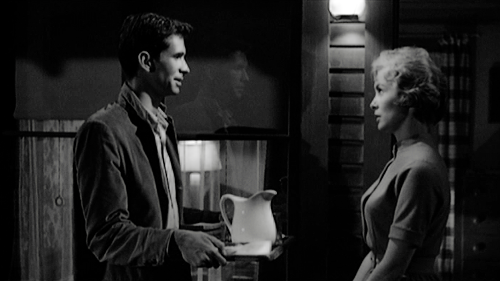
 Psycho uses mirrors (and windows/glass) for not only reflection and lighting but the psychological themes of inner thoughts and inner dialogue. It’s one of the few connecting tissues that when you notice it, it’s everywhere in the film. From the driving scenes with Janet Leigh, lights that heighten or create shadows, there’s a scene where Marion and Norman are talking and there’s a framed mirror next to Marion and there’s her reflection again. There are scenes where we are in complete darkness and one of our characters is almost shining in the light. These little moments are great for color theory and I don’t think we would have gotten the same conclusion if it were done in color.
That to me is a huge highlight of the film in general. We get to see the playing around of lighting, using objects to reflect, create mood and suspense with these tools and being experimental. And pushing the boundaries as well.
 Interior design, fashion design, and textures also bring out a cohesive balance to the film because despite being in black and white film, these things still matter.
I mentioned “principles of art” and “elements of art” earlier and I wondered if these could be applied to film. The answer is yes. For Psycho, there were a small handful that stood out to me. Both are connected together and depend on each other. The Elements of Art are line, shape, form, color, texture, space and value. The Principles of Art are emphasis, balance, harmony, variety, movement, rhythm, proportion and unity. These can be applied to all forms of art whether literal pieces of art, fashion, film making, etc. And here’s what I chose:
 Emphasis (composition refers to developing points of interest to pull the viewer’s eye to important parts of the body of work), Variety (refers to the differences in the work. You can achieve variety by using different shapes, textures, colors, values) and Movement (adds excitement to your work by showing action and directing the viewer’s eye throughout the picture plane). And on the other spectrum, I chose Shape (enclosed space defined by other elements of art, may be 2d or 3d objects), Color (element of art with 3 properties: hue, intensity and value) (I mentioned these in further depth with this post), Space (the distance or area between, around, above or within things) and Value (describes the darkness or lightness of color… needed to express volume).
There are others that can be applied here, even thought of either balance or unity and both are interchangeable but the next time you watch Psycho, remember to look at it from a different lens.
To finish out the post, I wanted to share this from the book “Nightmare Movies” by Kim Newman. He is also mentioning the film Peeping Tom (1960) and lumping the two films together as one: “Peeping Tom and Psycho are set up an everyday life full of grasping, petty characters and mindless minor brutalities. It’s impossible not to find Norman and Mark appealing. We are disturbed at our sympathy for such monsters, which cuts deeper than our liking for such wild children as the Frankenstein Monster and King Kong.”
 Yes, Psycho and its titular character of Norman Bates is a character that is charismatic and terrifying and realistic when it comes to serial killers, but the surrounding elements that Hitchcock provides to emote and create this world where it’s void of color yet color and it goes deeper than just a suspenseful, thriller, horror film. It is a great piece of film art.
On Wednesday, the 19th, we’ll be looking at a certain AMC series that has an immortal universe… til then, be good!
 Shots of Horror
Leave a comment